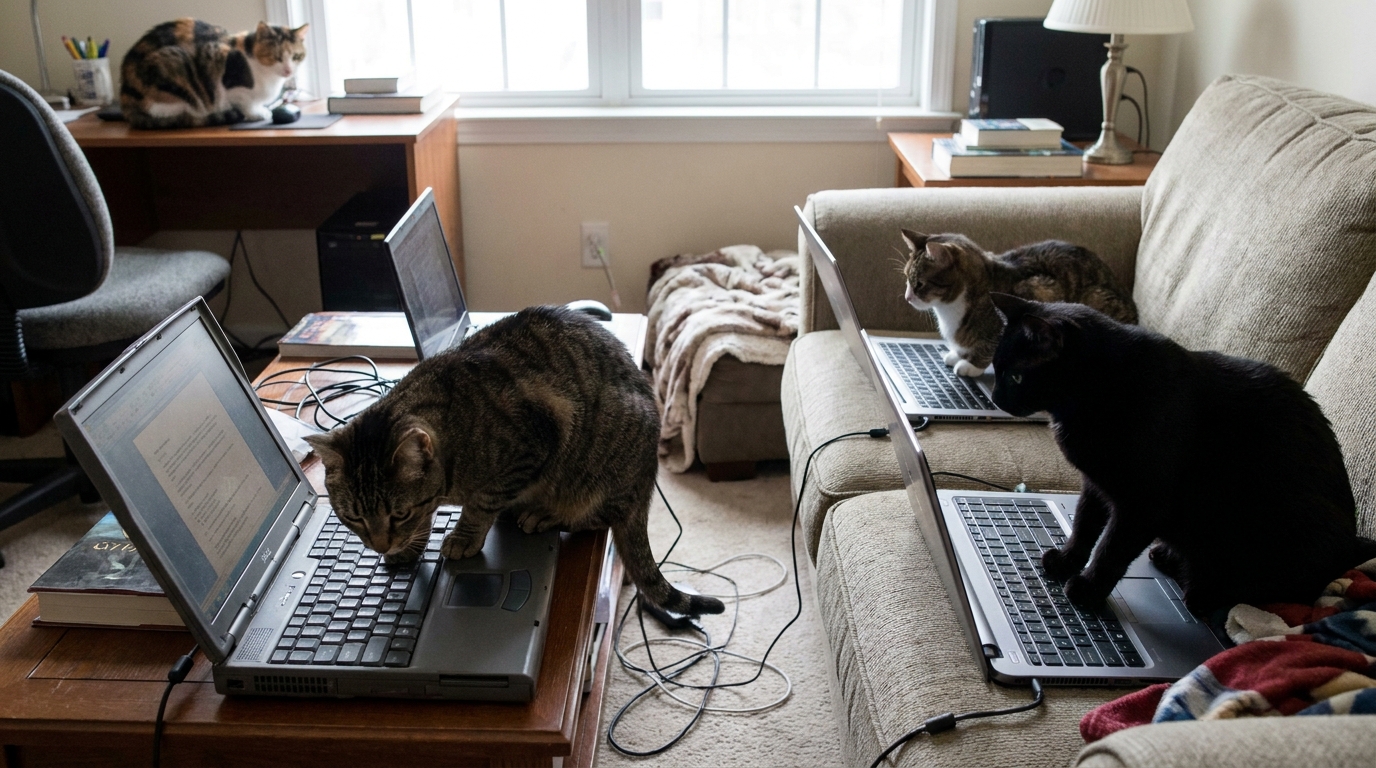
CAMBRIDGE - Researchers at the Institute of Feline Indifference published findings Wednesday confirming that domestic cats possess the cognitive ability to respond to their names and choose not to, a behavior lead author Dr. Stephen Voss called "active disengagement." The study, which tracked 600 cats across twelve households using collar sensors and hidden cameras, found that cats responded fastest to can openers and slowest to phrases including "time for a pill" and "we need to talk."
"We played recordings of owners saying 'treat' versus 'tax documents,'" Voss said. "Ear twitch latency differed by four hundred milliseconds. They know. They defer." The study's results suggest that cats are not merely being aloof but actively choosing when to engage with their human companions.
The research team used a variety of stimuli, including the sound of a can opener (which elicited immediate attention), the phrase "treat" (which also drew quick responses), and phrases like "time for a pill" or "we need to talk," which were met with indifference. Cats responded fastest when their owners mentioned food, followed by playtime, and showed the least interest during mundane household tasks.
Animal behaviorists say the results validate what owners suspected since ancient Egypt. "This is not aloofness," said Dr. Priya Nand. "This is queue management." She explained that cats have developed a sophisticated system of prioritizing their interactions based on the perceived value and timing of each engagement request.
The Cat Lobby, an industry group representing premium litter brands, welcomed the study and announced a campaign celebrating "mindful boundaries." The lobby's spokesperson, a cat named Whiskers who was present at the press conference, said, "Cats are not just pets; they're partners in the art of living. We encourage owners to respect their cats' schedules."
Owners expressed relief and betrayal. "I thought the vet's name was too hard," said Owen Kessler, whose cat Pancake responded only when Kessler whispered about salmon at 2 a.m. "Now I know it wasn't just my bad memory." Another owner, Lisa Thompson, added, "I've been calling him for years and he never even twitched! What am I supposed to do now? Hire a professional?"
Voss said further research will examine whether cats read text messages marked urgent. Early data suggests they do and still wait until convenient. "We're looking at how cats process digital communication," Voss explained. "It's fascinating because it could change our understanding of feline intelligence."
The study has sparked debate among cat owners, with some feeling vindicated by the findings and others questioning their own judgment. One owner, Jane Doe, said, "I've always thought my cat was just being a bit stubborn, but now I see it as strategic." Another, John Smith, admitted, "Maybe I should stop trying to get his attention at 3 p.m. when he's napping."
The implications of this research extend beyond the pet industry and into fields like artificial intelligence and human-computer interaction. Voss noted, "Understanding how cats manage their interactions could inform better design for technology that mimics or complements feline behavior." He added, "We might learn a thing or two from our feline friends about effective communication."
As the research continues, one can only wonder what other secrets these enigmatic creatures are keeping. For now, owners will have to navigate their cats' complex social strategies, perhaps with a new appreciation for the art of the subtle eye roll and the strategic silence.