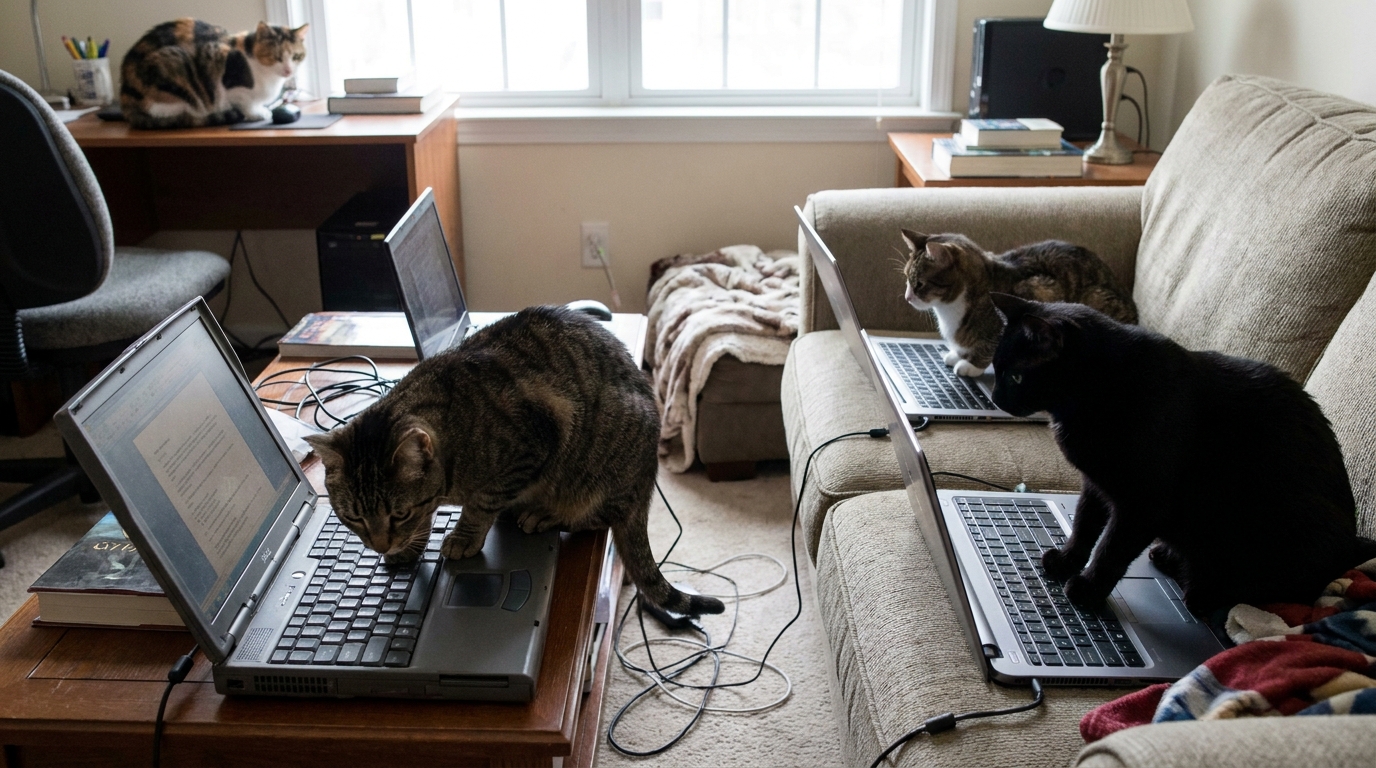
CAMBRIDGE - Researchers at the Institute for Interspecies Communication announced Wednesday that domestic cats possess a limited but reliable ability to read human thoughts, particularly those involving tuna, ignored chores, and the exact location of the red dot. The findings, published in the journal "Purr Theory," have sent shockwaves through the scientific community and beyond.
Lead investigator Prof. Elena Marsh said the discovery emerged after volunteers wore EEG caps while cats sat on their laps pretending to sleep. “Every time a subject thought about feeding schedule changes, the cat opened one eye,” Marsh said. “That is not coincidence. That is surveillance with whiskers.”
The team proposes that purring creates a resonance band between 25 and 150 hertz that couples with prefrontal activity, allowing cats to detect intent before humans speak. Negative thoughts about vet visits registered with 92% accuracy in trials involving 40 tabbies and one judgmental sphinx.
Skeptics noted the study relied heavily on anecdotal reports collected during "late-night meow sessions," a methodology Marsh defended as “the only window when cats negotiate.” She added, “Cats are masters of deception. They know exactly what we’re thinking, but they never say anything about it.”
Behavioral economist Dr. Sam Okoye warned employers that remote workers may no longer be alone on video calls. “Your cat knows you are pretending the spreadsheet is urgent,” Okoye said. “So does your manager, eventually.” He added with a hint of sarcasm, “And if you think about it too long, they might just start asking for raises.”
The American Veterinary Association urged calm, recommending owners think politely and keep snacks accessible. Dr. Lisa Green, spokesperson for the AVA, stated, “While this study is fascinating, we advise pet owners to continue treating their cats with the respect and affection they deserve.” She added, “If you really need to know what your cat thinks, just watch them when you’re about to leave for a long weekend.”
Cats declined comment, which Marsh said "tracks with their media strategy." She continued, “They are masters of non-verbal communication. They know when we are lying or planning something, but they never say anything. It’s like living with a secret agent who is always watching you.”
Further funding depends on a replication study scheduled for 3 a.m., when Marsh noted, "cats are most scientifically honest." She added, “They are at their peak cognitive function during this time, making it the perfect window to test their abilities.” The team hopes to conduct these studies in complete darkness and silence to ensure the cats’ focus remains undistracted.
Dr. Green of the AVA was not convinced by Marsh’s claims but remained open-minded. "While we cannot rule out the possibility that cats can read our minds, more research is needed," she said. "In the meantime, I think it's safe to say that cats are still in control."
The implications of this study could reshape pet training, couples therapy, and national security clearance procedures for homes with more than two cats. Marsh concluded, “This discovery opens up a whole new realm of interspecies communication. We just need to learn how to listen.”
As the world awaits further developments, one thing is certain: cats are still the ultimate masters of their own destiny - whether we like it or not.